Hunting the Wild Chicken


Welcome to Chitwan National Park where we can be sucked into the conspiracy for tourists to see the tiger and meet innocent primitive people.

After a day's tiring negotiation we arrange a reduced cost jungle safari. Our chances of seeing the tiger range between 70% and 99% - typical of Nepali calculations generally. How long is this bus to Kathamandu? “3,4,5 hours” “What time does the bus leave? “Maybe half an hour, maybe 2 hours” (actual wait: 4.5 hours) – just plucked out of thin air to appease the request, the best starting point is not to ask these silly western questions and simply assume that things are never going to happen so if and when they do then it is a nice surprise. Sitting on the roof of a bus with 150 people, your butt moulded into an iron bar, a sack of rice on top of you, a pregnant woman wedged behind and a random man stroking your leg – assume it is for eternity then when you arrive 5,6,7 hours later it's a nice surprise.

At the beginning of the jungle trek our safety talk encompasses a quick run down of approaches to death avoidance for respective different animals. Charging rhinos and elephants – climb at least 7 foot up a tree. Tigers and bears – huddle together. If things get hairy then we have two men in their sixties with big sticks to protect us, despite their many years of experience their look of terror is concerning as we observe two fighting rhinos in the bush – we hide behind a tree. The crocodiles we see are a safe distance, the bear we hear roar and the tiger we chase for a kilometre turns out to be a deer.


Traumatised Yann doesn't join us for day two – he takes a bus. The peak of excitement in day two involves spotting several wild chickens. Meanwhile Yann discovers a new Nepali family, they treat him like a king and his sister puts tikka on his forehead and adorns him in flowers. 


After twenty hours trekking I feel like Indiana Jones yet again in Nepal, the long grasses whipping me in the face. Worn, we arrive at the isolated community of Mardi where we are told the people give out of the goodness of their hearts. The week long Tihar Festival is in full swing. Bands of children come dancing round the houses with a tray for money. Rachael mistakes a thousand rupee note for a ten rupee note for her donation – the dancing goes wild. As word travels of the rich tourists in the village our lodging is bombarded until midnight with further groups – looking for massive donations to the “local book appeal” but in vain as we are retired to our concrete slab beds at 8.30pm. Resourcefully the villagers tag an additional day onto the festival and we awake to more dancing which turns into a full audience outside our rooms, observing our every moves, I feel like Madonna. The dancing turns into unashamed demands for money and cigarettes.


Our guides who we hired for 2 days are still hanging around on day 3, they interfere with any transaction we try to make and suddenly prices suspiciously increase. Although we are not paying them today they are getting free food for hanging around and taking a cut for translating. Irritated we send them away, quite able to buy our own bottles of coke. We escape our audience to walk to the old temple and happily accept the young village boys' offer to accompany us. Later as we leave the village we are harassed by ten year old boys demanding money for this “guided tour” and our 50 rupees offering is apparently insufficient.
   

Saddened by corrupted human nature we trudge across mud flats to wait 1,2,3 hours for a bus reflecting on the local myths of stupid foreign tourists.  

READMORE
 

Don't Go Back to Jomosom

Dancing with the kids down at the Rock Pokhara Festival the ghurkas befriend me, proudly speaking of their brothers fighting for HM British Army. They share whisky and sachets of white powder. Having wondered at the little metallic wrappers Nepali men discard onto the ground of their beautiful land I am happy to sample but soon disgusted - foul washing powder swill. It seems to be an aid for loud spits of phlegm (perhaps a mating call) that disturb the most serene Nepali moments.

The kids of this country enjoy a good pilgrimage whether joining school mates to celebrate graduation by dressing smartly and journeying 3 days into the Himalaya to bathe in holy springs and embrace the unique Nepali blend of Buddhist and Hindu faiths or by journeying on a 13 hour motorbike trip across half the country to see Miss Nepal present Rock Pokhara in a lakeside field.

Most guys I meet turn out to be wannabe tourist guides, even on the local bus, and can sort out anything I need, just call, so sweet, cute and amicable but not necessary. So, happy to meet the gurkhas I enjoy their stories of the pop bands. The boys bounce me up and down in excitement as a new band starts, fronted by a man in his 60s or 70s, topless with a wiry, sweaty body, large head and distinctive powerful face. He shouts to the crowd and the throngs of kids go wild at his inspirational political chat. The inordinate number of police at the festival may feel nervous – the state is paranoid of riots and has introduced an effective curfew and banned fireworks for this week's Divali - festival of lights. It is only 3 years since the end of a ten year civil war, only 20 years since the end of the King's absolute rule and only 60 years since Nepal opened its borders to the world.

The kids want hope and a better life and I am struck by the thoughtfulness and insight of those I speak to. Some boys tell me of their work in rural development and the struggle to support Nepal in providing access to drinking water, basic education and roads. The current Maoist president is popular and things are improving but chronic corruption persists.

I meet Muslims, Brahmins, Gurungs, Tahrus, Newaris.... Nepal comprises a complex mixture of ethnic groups and castes and I am heartened by a common Nepali welcoming and good nature. The flexible tongued Nepalis can learn any language, I try to learn their language and a minibus howls with laughter then I spend two weeks mistakenly saying “I have got a message for you” instead of “how are you?”

One of the gurkhas is drunk and excited, he insists that I join them in a van to Jomosom. After spending two full days risking my life escaping from Jomosom this cannot happen so I depart the festival. Back along the tourist funland of barefoot dreaded girls, hunky French paragliders, Israeli trekkers and restaurants which all insist in trying to serve food from every country in the world.

Back to my hotel to hide from the revolting overgrown orange haired hippy preaching aloud his rejection of society and The Testament According to Him, an ongoing dialogue since the 1970s regardless of the changing face of his audience. In a place where the locals are desperately trying to increase their material gains there is a convergence of westerners eager to apparently renounce worldly ties.

Escaped from the return to Jomosom I will go rafting and camp under the stars with a motley crew.


READMORE
 

Lessons Learned

Don't hire sleeping bags nor puffa jackets

Don't sleep in rooms with no windows

Always take an emergency blanket

Beat the mule train

Sit at back of jeep – this is better for jumping

Sit at left side of bus roof in crouched position – this is better for jumping

don't leave your posh flip flops next to the hot springs in the dark

bring a pipe and laxatives

sitting behind bus driver = face of phlegm

don't rub tiger balm on sunburnt nose

don't moisturise the locals, give them itch cream

Don't let Rachael near your stuff

Concentrate on game rules

Apple crumble on the mountain = apples in milky soup

don't cut off your circulation with your hair band/ cause + effect = elephantitis

Don't chase German lesbians after dark

Collect 26 people for bus journey

If you reach your destination alive you are lucky

Mind the goats/ snow leopard – prepare and make yourself big!

Hire Yann to redesign your Nepalese room and move your bed

Don't drive cranes over cliffs

Ensure your bus driver has started puberty before he drives your jeep down the treacherous mountain track

don't ask police silly questions

Always be yourself and keep quiet in large groups

Don't buy cheap gangrene rings

Don't squirt ketchup on the Chinese

Never tell Thai women your real name and address

Always pick up random foreign porters to sing in the wind down the lunar valley

Don't steal apples from old ladies

When the villagers come around dancing lock yourself in your room.

Don't encourage bad tourism by paying people on demand for things you didn't ask for (feet washing, spontaneous dancing, tikka on the forehead, guided tours, random information).

Always question peoples' motives.
READMORE
 

Annapurna Adventure


Bus ride to the mountains, depart Pokhara, reclining behind the driver dodging his morning phlegm ritual. As the caged machine overfills we clamber onto the roof joining Davy Gravy and Andrew the Great. New found sunspot ruined when 2 men sit on me, bottom moulded to the bars. Rachael and Dana carelessly discard their belongings from the bus in avoidance of wire beheading. We leap into action, off the bus and sprint down the road to retrieve the valuables.

A trekking group is formed (Andrew the Great of Poland, Davy the Gravy of Amsterdam, Yann the Dealer of Brazil, Doctor Dana of Colorado, Gypo Rachael of Southampton and King Philip) joining forces to harangue indifferent semi-bus-mafia-officialdom barking dodgy foreigner price hikes for forthcoming death cheating bus ride. Limboing under trees and wires as the bumpy bus rumbles along, leaden arms squeezing onto any seemingly static bags, rope and bars.


The mountain side appears to crumble like Cheshire cheese into the canyon below with a faint dint smudged roughly along its side as if some greater force had created an evil joke land with toy buses rattling through rocky roller coasters.

The bus edges along the dubious track and with each tilt of the bus one way we lean inwards, hopeful our weight and wishes will keep the bus from rocking and rolling over the edge. The full horror of our predicament becoming apparent I close my eyes and cling onto a rusty tyre shuddering until the bus slows to a stop. A group of monkeys jumping and plotting excitedly to jump on us, we howl....

Surprised to be alive, giddy with trauma to the disdain of dismayed foreigners caged inside, we arrive high with adrenaline. The trek begins...


Jagat and our hotelier friend confirms our fears about the deadly bus route then offers to be our guide (as does every third Nepali man) to prevent us from getting mountain sickness. We are sea level people and so more susceptible, particularly in the absence of a Nepali mountain man, we fear for Davy who is minus sea level (Netherlands).

Up the mountain we are soon amidst swarms of foreign trekkers sweating in the hot sun across scary Indiana Jones bridges. Stop for lunch to review the same generic and impossibly extensive menu despatched to all mountain restaurants. Aware that restaurant people are prone to run up and down the hill to fetch missing ingredients rather than decline customer requests we are keen not to cause any work and all order the same. Day Two Drama at lunch with Rachael's bed bug affliction revealed from the hired Puffa jacket, she resorts to gypsy kagool and crinkly gold blanket.


Day Three: Chame, quaint grey stone village, Tibetan and a man with a big gun guarding the remote bank. On arrival we drink delicious masala tea in a cosy wooden teahouse. A whole family works together to make samosas, children peeling potatos and Dad frying the samosas to a crisp in a large iron pan over a wood fire. Yann the Dealer undertakes his daily duty of hunting down rooms at special price, succeeding in securing space in the hotel of a moody rotund Tibetan lady who scolds us for being late for dinner. Delayed by our dusk visit to the hot spring. We join the local lads' evening gathering in the oblong stone bath to bathe in the murky hot spring water. The boys welcome us demonstrating their ritual of dipping in the water and leaping up into the cold air and sharing their home made whisky. The boys are unfazed by the girls joining in the communal bath. Next to us the Marsyangdi Khola roars past and the surreal spectre of a snow covered peak is etched.


  Day four - soldiering on past impossible German hikers in perverse lycra and mule trains. Onto Upper Pisang – a magical mountain village with wild marijuana growing along its steep windy lanes. We jump inside a marijuana field on arrival, aghast at the amount of weed around us. The village resembles a Tuscan farming village with patchwork brown and yellow fields and low brown stone houses. Elderly crooked folk wander the lanes carrying bales of hay and bags of apples on their backs grunting in gruff Gurung, lives unchanged for centuries. A white gompa overlooks the village and the valley at the top of the hill with ornate gold statues of the buddha inside. At the end of the day we climb the hill as a monk announces the daily ritual with an ominous clashing of the cymbal, long subliminal sounds echo deep inside. As the monks begin chanting, a spectacle for chattering tourists, we stretch our stoned bodies on the temple steps, breathing the Himalaya deep inside us, and looking up from our own yoga ritual a kind faced monk presents us with hot tea in metal cups. At one with the moment we sit in the cool air watching the light change, as the sun sets behind the mighty peak of Annapurna II. A patch of rose coloured light glows on its high peak slowly turning auburn, close enough to touch. A monk lights a fire of fir branches in a stone fireplace at the edge of the gompa complex, adding a comforting smell to the occasion and wafting misty smoke over the valley as villagers settle down to watch Goldfinger on satellite TV.
  
The boys chased out of town with a stoning by an old crone for pinching her apples. The beautiful secret valley opens up into rocky patches, fields of barley and herds of shaggy black yaks. White stupas are scattered around the valley and colourful prayer flags flutter in unlikely locations. Increasingly fascinated at the isolation of the communities we pass where everything is incredibly transported by donkey or man. Televisions, we learn, are brought on the backs of men because donkeys would smash them.

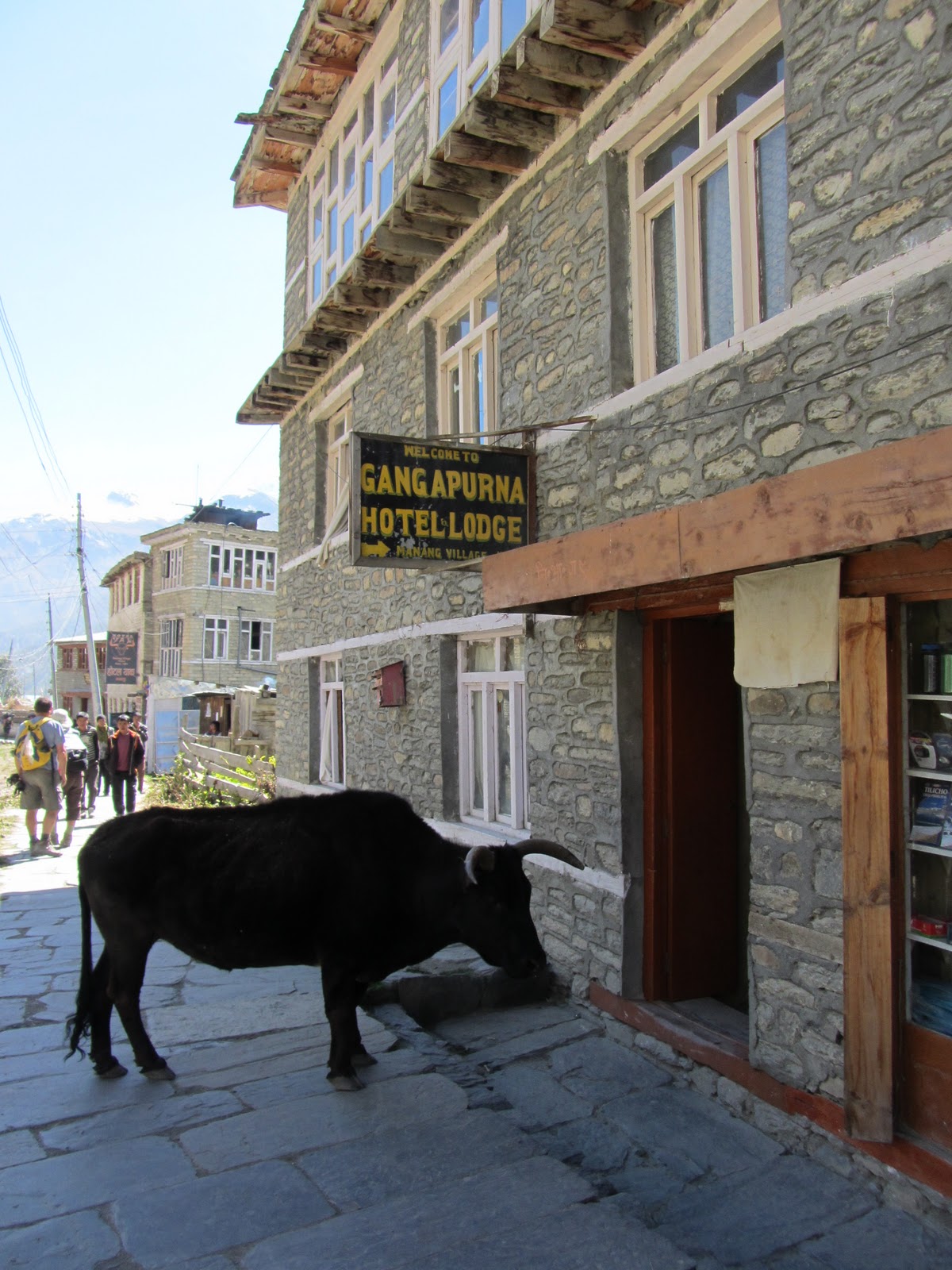
Onto Manang, a dormitory town for masses of tourists acclimatising in grey institution hotels before venturing up the great pass, an industry syphoning money money for electricity, honey and hot water. Respite in Hotel Moonlight, play cards, eat yak burgers and moisturise the locals. Looking out onto the dusty main street of this Wild West town where a random black bull patiently awaits his daily feed.

Then onwards to Banja and Somin's remote stone hut. Banja proudly welcomes us to his humble home with converted stables into bedrooms, padded with straw and newspaper. Thick mud walls insulate the hut and a sturdy iron range keeps us warm in the cosy kitchen watched over by shocking red eyes of a trophy dead baby deer and Yak head.

We pass the afternoon performing yoga for an audience of Nepali porters and sitting on a stone wall laughing and smoking. Banja and Somin lie together close by in the sunshine, close, in love, gazing curiously at the afternoon light entertainment. Somin, shy and reticent cannot hide her interest in our gathering who cackles and plots snow leopard avoidance techniques. A beautiful train of white donkeys trots by and in the distance a herd of hazel musk deer blend into the mountain. When a snow leopard kills a musk deer, Banja retrieves the beast for Somin to curry. The light changes in the valley below where three distinct mountains in our viewpoint criss crossing perfectly. A cold white mighty peak provides the backdrop for a dark brown diagonal intersected by a complimentary autumnal patchwork diagonal of greens, reds and browns shining gently in the autumnal sun. As the cold creeps in we retire into the warmth of the kitchen to select a meal from the ubiquitous and impossibly extensive menu.

Day 8 and onto Phede Base Camp, a hostile holding pen for foreign hikers and porters in the grip of mountain sickness paranoia, exhausted and nervous before attempting the great Thorung La Pass. The inhabitants of the refugee camp appear dirty, worn and slightly harrowed. In the face of adversity Yann re-designs the bedroom. Today sees The Return of Andrew The Great; the determined Pole storms into camp, hood up, dressed in black. We celebrate with garlic soup to stave off the mountain sickness.

The fearful day to cross the pass arrives. awake at 4.20am and the bizarre morning trek begins. Beneath the starlight an unlikely trail of head lit zombies trudges up a steep rocky climb and collapses breathless, frostbite setting in at Thorung High Camp. Replenished with milky tea we persevere on, the sun rising to warm the crisp air and the final push punctuated by five minute breaks. Time lengthens and the top of the pass falls further into the distance at every climb. Hillsides of sheer grey crumbling shingle surround the way. The mountain does not welcome us easily.

 As I round the final corner a random group of tourists applaud my arrival and I stumble happily to the pass, embraced by the cute Taiwanese girl. We spend some time celebrating and admiring dramatic views in the sharp bracing air before beginning the steep knee knocking descent into a new dimension. Down to Muktinath, otherworldly with its temples, orchards and dramatic canyon. A meeting of Hindu and Buddhist faith where pilgrims fling themselves into freezing holy water. I try to save my soul by filling my water bottle from the 108 holy spring water taps and giving a saddhu 15 rupees, let's hope it works, to save my soul returning down the mountain.
 With Subie, our newfound Indian porter in need, we continue down the mountain and into outer space. Stopping for lunch the hotelier regales us with stories of the neighbouring legendary King of Mustang who rules the neighbouring ancient kingdom of Upper Mustang. We peer in its direction, it looks like America's Grand Canyon.

Determined we continue through the moonscape, undeterred by rushing winds onto the ugly settlement of Jomosom then beyond in the dusk Soubie sings happy Punjabi songs Philip shields the troops from deadly dangers and Andrew The Great soldiering in front, heading the troop.


  Relieved to discover the lovely village of Marpha we locate our friends at Hotel Paradise where we merrily proceed to drink, smoke and laugh. Happy to be alive, feet warmed by coals we fill Paradise with laughter and love, reminding the hotel lady of her youth and pleasing her with our eager purchase of whisky. Party time is over when the teenagers are reprimanded by the Australian gays to halt the party forthwith.

A rest day passed with Rachael the Gypo telling our fortunes then day Twelve and to the horror of the lovely hotel lady the group begins to separate so she packs us off with fresh bread and cheese. All disperse on respective life threatening vehicle rides only to meet up again at another miserable mafiose bus station full of buses, no drivers and angry Israelis. After a four hour delay we eventually board a bus, left to sit in a cramped aisle, once again fearing for my life as the bus swerves round hairpin bends rocking unsteadily from side to side, shielding my face from the wafts of dust and from the truth of the cliff drop. It gets dark and the bus is still rocking on through the middle of waterfalls. Stuck another night on the mountain we take shelter then a second day of trauma we take a lift with a teenage boy driving a jeep manically down the treacherous road topped with gas cannisters.

Dirty, weary and desperate we reached Pokhara and proceed to battle with hoteliers for a cheap room.
READMORE
 

Tashi Palkhel


Wrinkled round faced ladies wrapped in beige
approach the stupa,
eyes closed.

Straighten, fold and flatten
like caterpillars
rise, repeat and circle.


Sublime chanting
punctuated by deep trumpet
echoes in the courtyard.


Peaceful purple and simple
monks welcome and provide
stability for a depressed community.

Humanity shines through solemnity
of the daily ritual
with yawns and baby giggles.

Buddha is honoured,
foreign money constructs another grand monastery
and rain leaks into tin shack homes. 
 Water buffalo roam ramshackle lanes
the colours of Tibet flutter in the wind
an imaginary flag house on the hill.

Fifty years of exile
uncertain acceptance in an alien land
a nation cannot be erased.

t
Talshi Palkhel - Tibetan refugee settlement near Pokhara, Nepal
READMORE